
Complete PDF
The full proofread research record.
Read every page, equation, limitation, appendix, and reference without leaving Qalice.
pages
core sections
appendices
technical references
If your browser cannot display the embedded document, open the complete PDF directly.
Web companion
A feedback architecture for the quantum layer.
Quantum mirroring is proposed as a system-level feedback framework that joins observation, state estimation, simulation, photonic control, and adaptive response.
The goal is not to claim a finished physical device. It is to define testable interfaces and experiments for studying whether mirror-like control loops can improve state transfer, stability, and network behavior under realistic loss, noise, delay, and imperfect measurement.
Foundations
Observe. Estimate. Reflect. Correct.
The framework treats a mirror as more than a passive surface. A logical node measures available observables, updates an internal model, chooses an allowed response, and records the result. The loop can represent gate-model controls, optical switching, adaptive optics, or a hybrid quantum-classical protocol.
Quantum state
Density matrices, entanglement, fidelity, and measurement statistics.
Network state
Loss, latency, synchronization, authenticated classical feed-forward.
Control boundary
Named experiments, constrained operations, complete run manifests.
Architecture
The Qalice node-pair model.
Two logical nodes coordinate quantum interfaces, optical modes, authenticated classical control, and a shared experiment record. Each layer can be simulated independently before being composed.
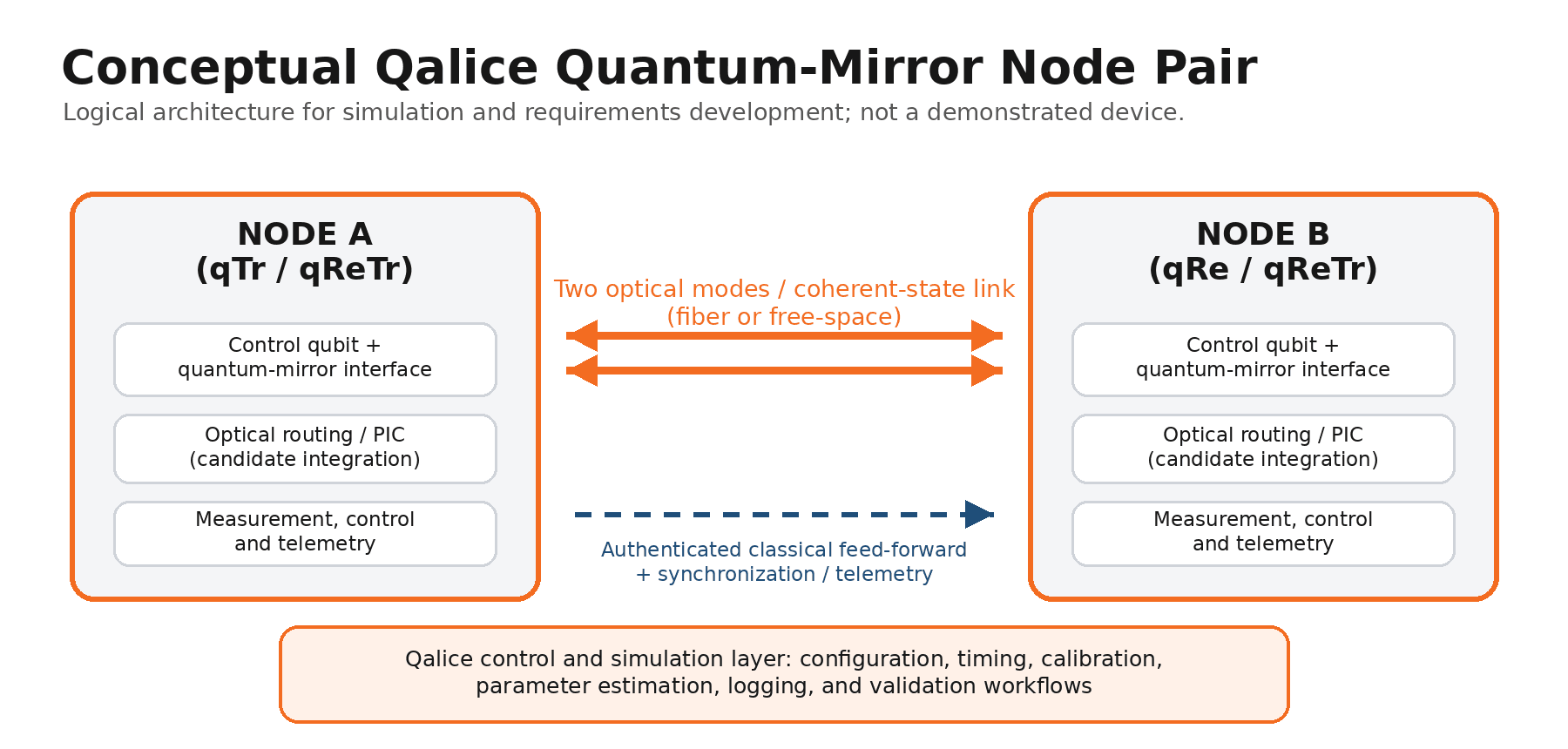
- 01
Quantum interfaces
Prepare, transform, and measure the states used by a reviewed experiment.
- 02
Photonic transport
Represent optical modes, attenuation, phase, coupling, and receiver response.
- 03
Classical coordination
Authenticate feed-forward messages and retain timing, backend, and calibration context.
Protocol
Measure performance, not mythology.
A valid experiment declares the circuit or optical model, parameter ranges, shot count, backend, noise assumptions, random seed, software versions, timestamps, and result hashes.
Results must report uncertainty and failure modes. A high simulator fidelity is evidence about the stated model—not proof that a corresponding physical mirror exists.
Implementation
From local reference to IBM hardware.
Qalice uses three execution tiers: a deterministic local gate-model reference, a non-ideal photonic digital twin, and authorized IBM Quantum jobs for compatible gate subcircuits.
Local finite-shot simulator
Fast, reproducible baseline runs with explicit seeds and no external credentials.
Non-ideal photonic twin
Loss, visibility, pointing, detector response, and latency sensitivity.
IBM Quantum Runtime
Bell, teleportation, tomography, and noise baselines on supported gate-model systems.
Astro
Laser and photonic energy infrastructure.
Astro Qalice is a classical photonic systems research program exploring how energy and information might be converted, transported, redirected, and received during future exploration and resource operations.
Candidate studies include lunar shadow-region support, excavation and sensing, beneficiation and volatile handling, in-situ resource utilization, relay networks, thermal control, and space-to-space energy transfer. Every link budget must declare wavelength, power, aperture, divergence, range, pointing error, receiver efficiency, rejected heat, and fail-safe logic.
Open the Qalice Astro simulatorRoadmap
Build evidence in layers.
- Now
Reproducible software
Named simulations, manifests, tests, and explicit uncertainty.
- Next
Bench validation
Classical optical hardware-in-the-loop measurements and calibrated noise models.
- Then
Quantum-compatible experiments
Constrained gate-model tests and photonic component characterization.
- Horizon
Responsible field systems
Safety cases, governance, thermal design, pointing assurance, and mission-specific review.
Qalice advances by making the next test clearer. The project does not collapse hypothesis, simulation, and deployment into a single claim.
References
References.
External research is preserved here as scholarly context for the Qalice-authored program.
- M. Uria, C. Hermann-Avigliano, P. Solano, and A. Delgado, “Alice and Bob through a quantum mirror,” arXiv:2603.18371v1 (2026).
- R. Bekenstein et al., “Quantum metasurfaces with atom arrays,” Nature Physics 16, 676–681 (2020).
- K. Srakaew et al., “A subwavelength atomic array switched by a single Rydberg atom,” Nature Physics 19, 714–719 (2023).
- K. Azuma et al., “Quantum repeaters: From quantum networks to the quantum internet,” Reviews of Modern Physics 95, 045006 (2023).
- S. Wehner, D. Elkouss, and R. Hanson, “Quantum internet: A vision for the road ahead,” Science 362, eaam9288 (2018).
- C. H. Bennett et al., “Teleporting an unknown quantum state via dual classical and Einstein–Podolsky–Rosen channels,” Physical Review Letters 70, 1895–1899 (1993).
- M. Uria et al., “Continuous-variable quantum-state tomography enabled by quantum mirrors,” arXiv:2606.04277v1 (2026).
- J.-G. Ren et al., “Ground-to-satellite quantum teleportation,” Nature 549, 70–73 (2017).
- M. Petrovich et al., “Broadband optical fibre with an attenuation lower than 0.1 decibel per kilometre,” Nature Photonics 19, 1203–1208 (2025).
- M. A. Nielsen and I. L. Chuang, Quantum Computation and Quantum Information, 10th Anniversary Edition (2010).
- E. T. Jaynes and F. W. Cummings, “Comparison of quantum and semiclassical radiation theories with application to the beam maser,” Proceedings of the IEEE 51, 89–109 (1963).
- C. W. Gardiner and P. Zoller, Quantum Noise, 3rd ed. (2004).
- R. K. Tyson, Principles of Adaptive Optics, 4th ed. (2015).
- IBM Quantum Documentation, Qiskit Runtime REST API, API version 2026-04-15.
- IBM Quantum Documentation, primitives and Qiskit Runtime execution modes (2026).
- NASA Space Technology Research Grants, “Moonbeam—Beamed Lunar Power” (2026).
- NASA TechPort Project 118529, “High Efficiency Laser Power Beaming Receivers for Lunar and Extraterrestrial Exploration” (2026).
- W. A. Ruperto Hernandez et al., “Orbital Power Beaming to Provide Increased Mobility, Flexibility, and Science Measurements on the Lunar Surface,” NASA NTRS 20250003718 (2025).