Feedback-driven stabilization, observation, simulation, photonic control, and adaptive system response.
Read the full whitepaper QALICEOpen quantum lab
Journeying through the
quantum glass.
A rigorous path from quantum-mirror hypothesis to reproducible simulation, photonic networks, and future space systems.
Local simulator ready · IBM Quantum optional
Mirror node AMirror node BMirror node C
From hypothesis to hardware.
A public record of the idea.
Qalice defines quantum mirroring as a system-level feedback framework spanning observation, simulation, photonic control, and adaptive response.
“A dynamic feedback loop intended to stabilize qubit states, counter decoherence, and preserve entanglement.”
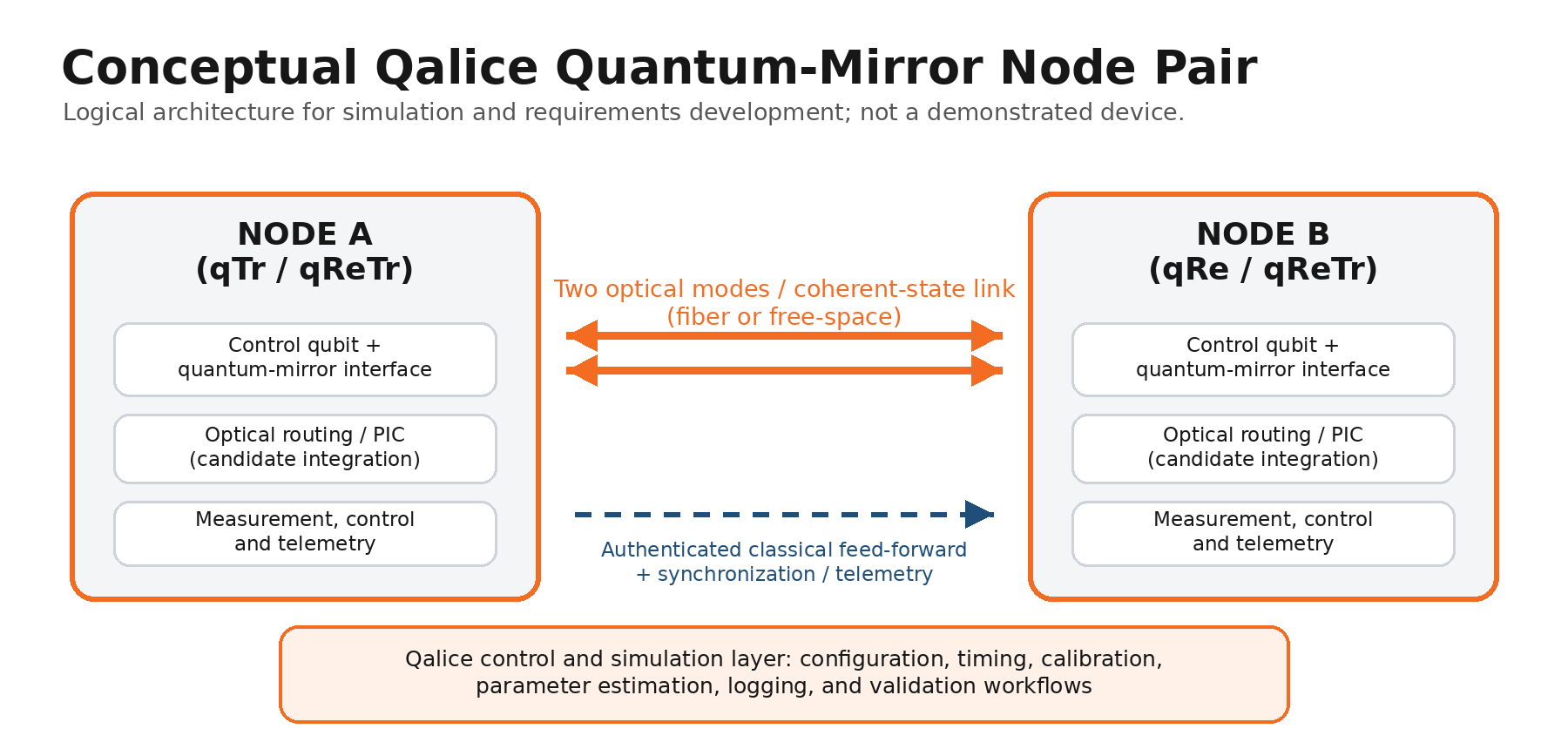
The quantum-mirror network.
Two logical nodes coordinate optical modes, authenticated classical feed-forward, and a shared simulation layer.
- 01Quantum interfaceControl qubits and mirror interfaces at each node.
- 02Photonic transportCoherent-state optical links connect the nodes.
- 03Classical controlAuthenticated feed-forward and synchronized telemetry.
Run the mirror protocol.
Start locally. Connect IBM Quantum when hosted credentials are configured.
CircuitMirror protocol
q0
q1
HHXMMH HadamardX Pauli-X Control Target
CountsAwaiting run
00011011Fidelity proxy—
ExecutionLocal statevector
Simulator ready
Secure IBM boundaryChecking secure configuration…
IBM superconducting QPUs can validate gate-model subcircuits and noise baselines. They do not natively reproduce coherent optical modes or a physical quantum metasurface; those require a photonic/open-system simulator and, ultimately, laboratory hardware. IBM Runtime API reference ↗
Photonics for the long distance.
Lasers move information efficiently today. Future space infrastructure may also use directed optical energy for power beaming, sensing, and coordination—subject to pointing, thermal, safety, and conversion constraints.
Now · optical communications
Next · precision sensing
Horizon · directed energy transfer
Astro is a research horizon, not a deployed claim.
Explore astro.qalice.comOrbital relay
Mining craft
One Qalice research program.
The hypothesis, executable model, photonic architecture, and space-systems horizon are documented together with explicit evidence boundaries.
Laser conversion, mirror relays, link budgets, sensing, and future space-resource operations.
Open the Astro simulatorQalice separates demonstrated capability, modeled engineering, and future hypotheses. External research appears only where it belongs: in the whitepaper references.
QALICEIndependent research, built in public.
Keaton R. McCune is the founder of Qalice. The work explores quantum communication, computation, security, photonics, and energy systems through openly documented hypotheses and reproducible software boundaries.